

HR technology has moved beyond traditional systems and manual processes. Organisations now use chatbots, robotic process automation, artificial intelligence, and increasingly, AI agents to improve employee service and automate HR work.
But these technologies do not solve the same problems.
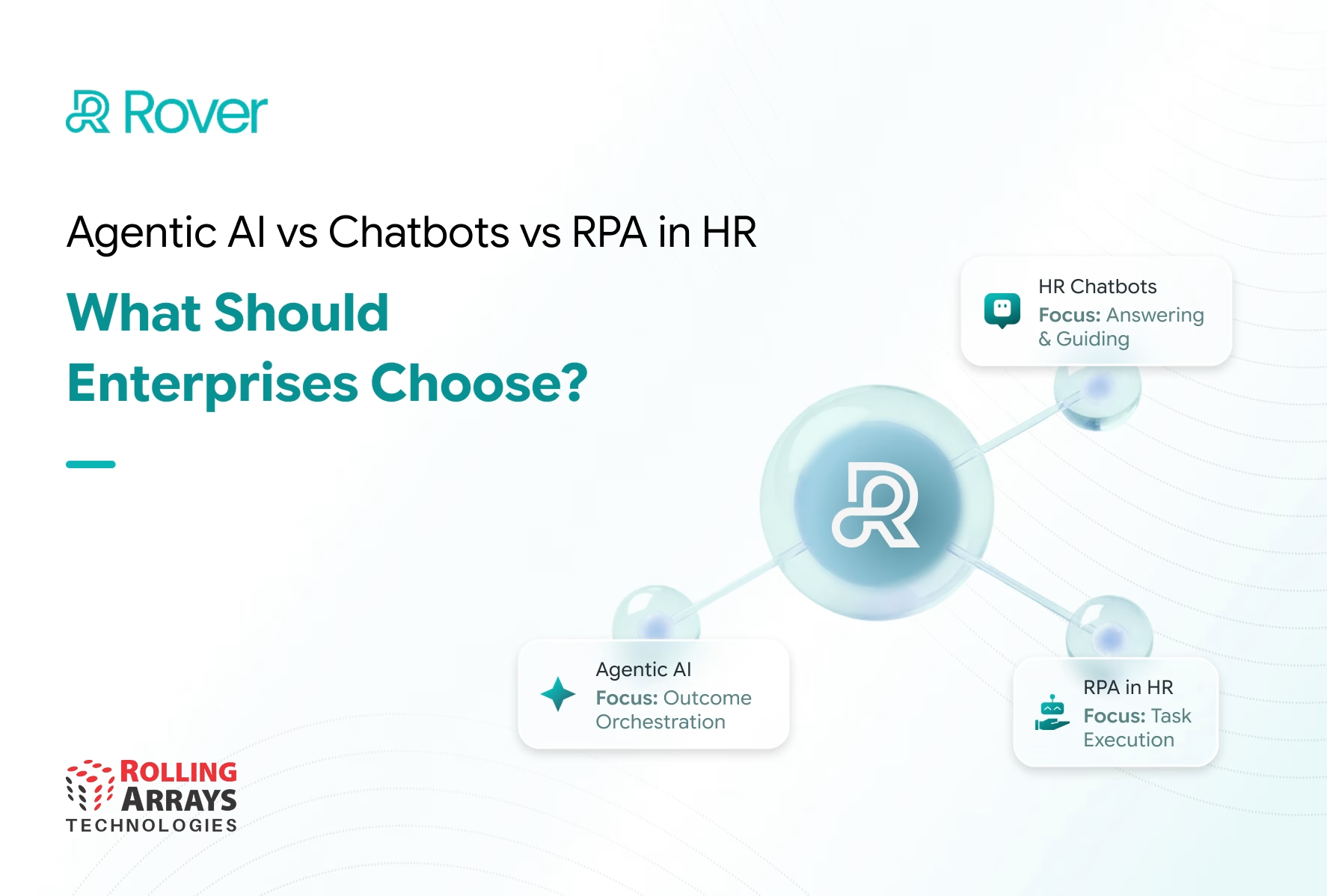
An HR chatbot can answer an employee’s question. RPA can execute a predefined task repeatedly. Agentic AI can understand an objective, reason through the required steps, coordinate actions, and support decisions within defined boundaries.
For CHROs, the important question is therefore not simply which technology is newer. It is which technology addresses the business problem the organisation is trying to solve.
Understanding the differences between HR chatbots, RPA in HR, and Agentic AI can help organisations build an AI strategy that improves employee experience while maintaining appropriate governance and human oversight.
Why Should CHROs Look Beyond Traditional HR Automation?
Many organisations have already invested in HR automation.
Yet HR teams can still spend significant time handling repetitive employee requests, managers can still navigate multiple systems, and employees can still struggle to complete complex HR processes.
This creates several questions for HR leaders:
- Which processes should organisations automate?
- Which employee interactions require conversational support?
- Where can AI make decisions or recommendations?
- Which processes still require human judgement?
- How can organisations improve employee experience without replacing existing HR systems?
The answer depends on the nature of the problem.
A repetitive, predictable process may benefit from RPA. A straightforward employee question may suit a chatbot. A complex, multi-step employee journey may require Agentic AI.
What Are HR Chatbots Designed to Do?
HR chatbots primarily help employees interact with HR through conversation.
Instead of searching through an HR portal or knowledge base, an employee can ask a question in natural language.
For example:
“How many days of annual leave do I have?”
A chatbot can retrieve the relevant information and provide an answer.
Common HR chatbot use cases include:
- Answering HR policy questions
- Providing employee information
- Helping users find HR resources
- Supporting frequently asked questions
- Guiding employees toward relevant HR processes
- Providing basic employee self service
The benefits of chatbot in HR include easier access to information, reduced repetitive questions for HR teams, and a more conversational employee experience.
However, traditional chatbots generally focus on answering or guiding.
When an employee needs to complete a complex workflow involving multiple steps and systems, a chatbot may not be enough.
What Is RPA in HR?
Robotic Process Automation uses software bots to execute predefined, repetitive tasks based on established rules.
RPA works particularly well when the process is predictable and follows a consistent sequence.
Common RPA in HR use cases include:
- Moving employee data between systems
- Generating routine reports
- Processing repetitive administrative tasks
- Updating records based on predefined conditions
- Supporting payroll-related processes
- Automating repetitive data entry
The strength of RPA is consistency.
Once an organisation defines the process and rules, the bot can execute those steps repeatedly without requiring someone to perform the task manually.
However, RPA generally does not understand an employee’s broader goal or independently determine what the process should be.
It follows the instructions it receives.
What Makes Agentic AI Different?
Agentic AI introduces another level of capability.
Instead of simply responding to a question or following a predefined script, an AI agent can understand the user’s objective, consider context, determine the steps required, and coordinate actions across connected systems.
For example, imagine a manager says:
“I need to hire someone for my team.”
The manager may not know which HR module to open or which process to initiate.
An AI agent can interpret the goal and guide the manager through the relevant journey.
That journey could involve:
- Initiating a headcount request
- Supporting approval
- Creating or progressing a requisition
- Helping review candidates
- Coordinating interviews
- Supporting offer-related activities
- Initiating onboarding after selection
The key difference is that Agentic AI works toward an outcome rather than simply answering a question or executing a fixed script.
RPA vs AI: Which One Should HR Use?
The question should not always be RPA vs AI.
Both technologies can play different roles within an HR automation strategy.
Use RPA when:
- The process is repetitive
- Rules are clearly defined
- Inputs and outputs are predictable
- The same steps occur repeatedly
- Little contextual reasoning is required
Use AI when:
- The process involves natural language
- Users need contextual guidance
- Information needs interpretation
- Recommendations can improve the process
- The workflow involves varying user needs
Use Agentic AI when:
- The user has a broader objective
- Multiple steps need coordination
- Several systems may be involved
- The process requires contextual reasoning
- AI needs to determine appropriate next actions
- Human approval remains important at specific stages
The technologies can also work together. RPA can execute repetitive back-end activities while AI agents manage the broader interaction and workflow.
How Does Agentic AI Improve Employee Experience?
For CHROs, technology decisions ultimately need to connect to employee and business outcomes.
Employees rarely think in terms of HR modules.
They think:
“I need to take leave.”
“I need help with my benefits.”
“I need to hire someone.”
“I need to complete my performance review.”
The underlying process may span multiple systems and steps.
An Agentic AI experience can provide a single conversational entry point and guide employees or managers through those journeys.
This can reduce:
- System navigation
- Repetitive questions
- Manual coordination
- Process confusion
- Administrative effort
This is where an employee experience platform can become more than another HR destination. It can act as an intelligent layer connecting people with the HR systems and processes they already use.
What Should Enterprises Consider Before Choosing an AI Approach?
Technology selection should start with the problem rather than the technology.
Identify the Type of Work
Determine whether the problem involves information retrieval, repetitive execution, contextual guidance, or multi-step decision-making.
Map the Employee Journey
Look beyond individual tasks.
Understand where employees and managers encounter friction from the beginning to the end of a process.
Define Human Decision Points
Not every HR decision should become automated.
Identify where managers, HR professionals, or other authorised individuals need to review and approve actions.
Consider Existing Systems
The organisation may already have significant investments in its HRIS.
The objective should be to make those systems easier to use and more connected rather than automatically replacing them.
Measure Business Outcomes
Evaluate technology through outcomes such as:
- Reduced administrative effort
- Faster process completion
- Higher employee self service
- Improved manager productivity
- Reduced HR support volume
- Better employee experience
Where Does Rover Fit?
Rover represents the Agentic AI category for enterprises using SAP SuccessFactors.
Rather than positioning AI as another standalone HR tool, Rover provides a conversational experience across HR processes and uses agentic capabilities to guide employees, managers, and HR teams through multi-step journeys.
For example, a manager can initiate a hiring journey conversationally rather than navigating multiple HR screens. Rover can coordinate relevant steps, provide contextual guidance, and involve people when approvals or critical decisions require human oversight.
This is particularly relevant for CHROs who want to move beyond isolated automation and create a more connected employee experience.
The distinction is important:
Chatbots help employees find answers.
RPA helps organisations automate repetitive steps.
Agentic AI helps people accomplish complex outcomes.
Rover is built around the third approach.
How Should CHROs Think About the Three Technologies?
There is no universal need to choose one technology for every HR process.
A mature HR technology strategy can use all three.
Chatbots can handle straightforward questions and information requests.
RPA can automate predictable, repetitive processes.
Agentic AI can orchestrate complex employee journeys that require context, reasoning, recommendations, and coordinated actions.
The strategic opportunity for CHROs is to understand where each technology creates the most value.
The goal is not to automate HR simply because automation is possible.
The goal is to make HR easier to access, easier to operate, and more effective for employees, managers, and HR teams.
Frequently Asked Questions
What is the difference between an HR chatbot and Agentic AI?
An HR chatbot primarily answers questions and guides users through predefined interactions. Agentic AI can understand broader goals, reason through required steps, coordinate workflows, and support actions across connected systems.
What is the difference between RPA and AI in HR?
RPA follows predefined rules and scripts to automate repetitive tasks. AI can interpret information, understand context, and provide recommendations. Agentic AI can extend this further by coordinating multi-step workflows toward a defined outcome.
What are common RPA in HR use cases?
Common use cases include repetitive data entry, system-to-system data movement, routine reporting, record updates, and other predictable administrative processes.
What are the uses of AI in HR?
AI can support employee self service, recruitment, workforce insights, HR automation, employee support, recommendations, learning, performance processes, and complex employee journeys.
What are the benefits of HR chatbots?
HR chatbots can provide faster access to information, reduce repetitive HR questions, improve employee self service, and give employees a conversational way to access HR support.
When should an enterprise use Agentic AI in HR?
Agentic AI is particularly relevant when a process involves multiple steps, systems, stakeholders, or contextual decisions and employees need support moving from an initial request to a completed outcome.
Can RPA, chatbots, and Agentic AI work together?
Yes. Enterprises can combine the technologies. A chatbot can provide the conversational interface, RPA can execute predictable back-end tasks, and Agentic AI can coordinate more complex workflows and determine appropriate next actions within defined boundaries.


