
Employee feedback is most valuable when organizations collect it at the right moment. Yet many HR teams still rely on manual processes to create surveys, identify employee groups, distribute questionnaires, send reminders, and analyze responses. As organizations grow, managing these activities across different departments and employee groups becomes increasingly difficult.
Employee feedback survey automation helps HR teams move beyond repetitive administration and build more consistent feedback processes. By connecting survey workflows with employee information and lifecycle events in SAP SuccessFactors, organizations can make feedback collection more relevant, timely, and manageable.
ReeCollect, an AI-first employee feedback platform built for SAP SuccessFactors, helps organizations automate survey creation, distribution, and analysis while using employee context to support personalized feedback experiences.
Why Manual Employee Survey Management Becomes Difficult at Enterprise Scale
For CHROs, employee feedback is not simply a way to measure satisfaction. It provides visibility into employee experiences, identifies areas that require attention, and helps leaders understand how HR initiatives affect the workforce.
However, collecting meaningful feedback across a large workforce requires more than creating a questionnaire.
HR Teams Spend Too Much Time Managing Survey Operations
Consider an organization onboarding hundreds of employees across multiple business units.
The HR team needs to identify eligible employees, prepare onboarding surveys, determine when to distribute them, send reminders, and consolidate the responses.
If these activities depend on manual coordination, the process becomes repetitive and difficult to scale.
The same challenge applies to engagement surveys, learning feedback, performance reviews, and other employee feedback programs.
Generic Surveys Miss Important Employee Context
An employee who has recently joined an organization has different feedback requirements from an experienced employee completing a performance review.
Sending identical questions to everyone may produce responses that lack the context HR leaders need.
Without relevant employee information, HR teams may struggle to tailor questions to different roles, departments, and employee experiences.
Delayed Feedback Makes It Harder to Understand Employee Experiences
Timing plays an important role in feedback quality.
When HR collects feedback long after an employee experience, employees may find it harder to recall specific interactions or challenges.
For example, asking a new employee about their onboarding experience several months after joining may not provide the same level of detail as collecting feedback closer to the onboarding process.
HR teams need a more structured way to connect feedback collection with relevant employee moments.
What Is Employee Feedback Survey Automation?
Employee feedback survey automation uses software and predefined workflows to manage different stages of the survey process.
Instead of manually coordinating every survey, HR teams can configure workflows that support survey creation, audience targeting, distribution, reminders, and response analysis.
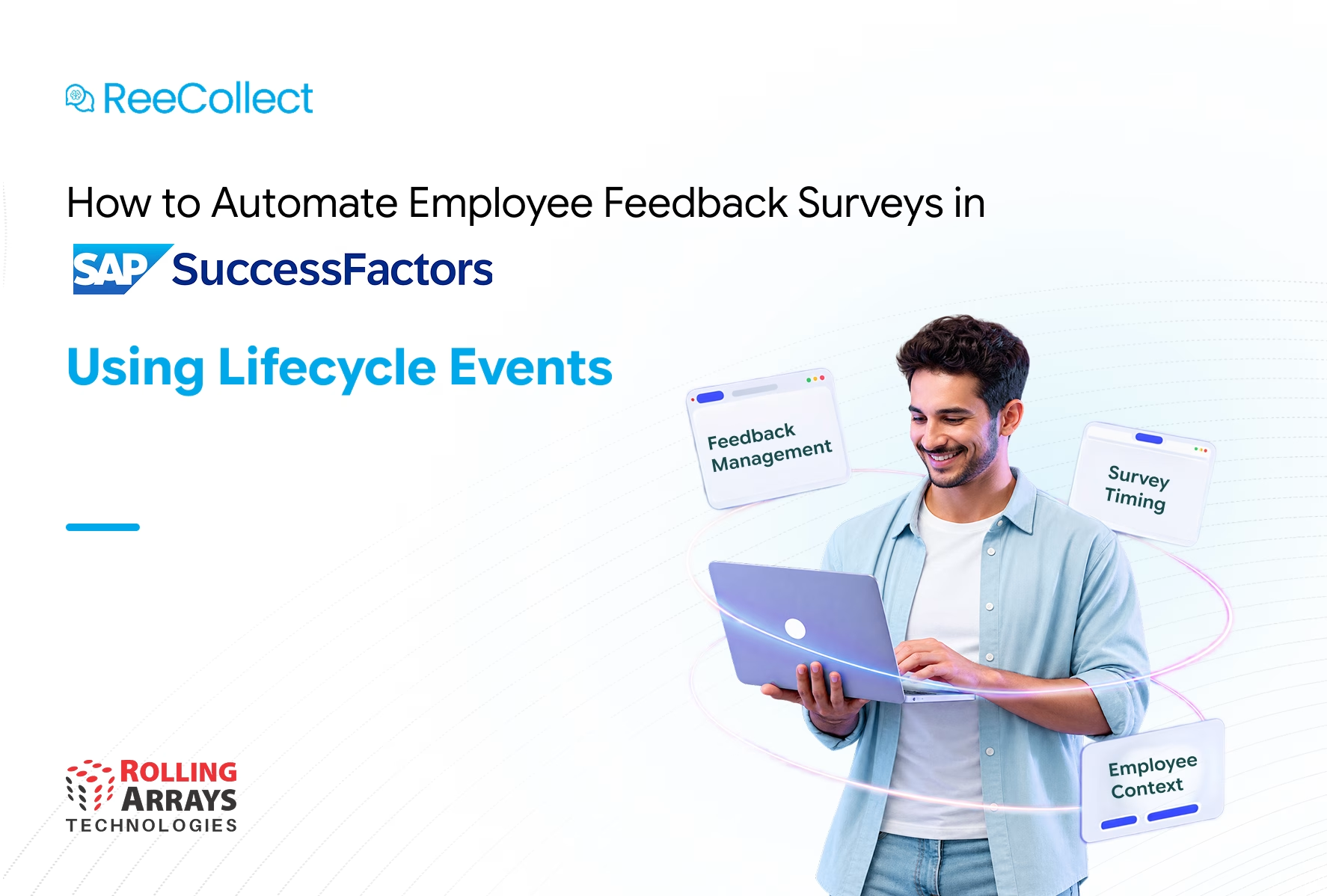
A well-designed employee survey workflow automation process connects three important elements:
- Employee context: Relevant employee information, such as role, department, and lifecycle stage.
- Survey timing: The appropriate moment to request feedback based on the purpose of the survey.
- Feedback management: Consistent distribution, collection, and analysis of employee responses.
When these elements work together, HR teams can reduce repetitive administration and deliver more relevant feedback experiences.
Connect Employee Lifecycle Events with Automated Surveys
Employee lifecycle events provide useful opportunities to collect feedback.
These events represent important moments in an employee’s relationship with the organization. Rather than waiting for a periodic engagement survey, HR teams can use relevant employee processes to determine when feedback may be valuable.
Trigger Onboarding Surveys at the Right Time
The onboarding experience influences how employees understand their roles, connect with their teams, and settle into the organization.
However, HR teams may not always know whether new employees receive the support and information they need.
Automated onboarding surveys can help organizations collect feedback at relevant stages of the onboarding journey.
For example, HR may want to understand:
- Was the joining process smooth?
- Did the employee receive the necessary information and resources?
- Was the employee introduced to the team and manager effectively?
- Does the employee understand their responsibilities?
- What improvements would make the onboarding experience better?
Connecting onboarding feedback with employee information in SAP SuccessFactors helps HR teams target the relevant employee group and collect feedback in a more structured manner.
Collect Feedback Around Learning and Development
Learning programs require more than attendance and course completion records.
HR leaders also need to understand whether employees find training relevant, whether learning objectives are clear, and whether employees can apply what they learn.
Employee lifecycle surveys can support feedback collection around learning experiences and development initiatives.
This helps HR teams understand the employee experience beyond basic learning participation metrics.
Capture Feedback Around Performance and Role Changes
Performance discussions and changes in responsibilities can influence employee expectations and engagement.
Feedback around these experiences can help organizations understand whether employees receive sufficient guidance, whether expectations are clear, and whether managers provide the necessary support.
HR teams can use relevant employee processes as opportunities to collect contextual feedback, subject to the configured workflow and available integration capabilities.
How ReeCollect Automates Employee Feedback Surveys in SAP SuccessFactors
Managing employee surveys should not require HR teams to maintain a separate manual process for every employee group.
ReeCollect extends SAP SuccessFactors with AI-powered employee feedback capabilities. It uses employee profiles, roles, and key moments from SAP SuccessFactors to support relevant survey deployment and personalized feedback.
It also automates the survey lifecycle, helping HR teams manage survey creation, distribution, and analysis within the SAP SuccessFactors environment.
1. Use SAP SuccessFactors Employee Context
ReeCollect connects with employee information in SAP SuccessFactors to understand relevant workforce context.
This information can support survey targeting and personalization based on factors such as employee roles, competencies, engagement history, and other relevant employee data.
HR teams can use this context to create feedback experiences that reflect the employee’s situation rather than relying entirely on generic questionnaires.
2. Create Surveys with AI Assistance
Creating different questionnaires for multiple employee groups can consume considerable HR time.
ReeCollect uses AI to recommend and generate context-aware survey questions based on the purpose of the feedback program and relevant employee information.
For example, an onboarding survey can focus on the joining experience, while a performance-related feedback program can address a different set of questions.
This reduces the manual effort involved in preparing surveys while helping HR teams maintain relevance across feedback programs.
3. Configure Survey Distribution and Targeting
Once the survey is ready, HR teams can configure its audience and launch settings.
ReeCollect supports audience targeting, including options such as new joiners and departments, along with survey scheduling and reminder frequency settings.
This helps HR teams organize employee feedback distribution without repeatedly coordinating every activity manually.
For lifecycle-based programs, the relevant employee event and survey workflow should be configured according to the organization’s SAP SuccessFactors environment.
4. Make Feedback Collection Easier for Employees
Even well-designed surveys can struggle if employees find them difficult to access or complete.
ReeCollect supports employee feedback collection through an integrated experience, including QR-code access.
Its AI-assisted conversational interactions can also adapt questions based on employee responses, helping organizations collect more contextual feedback than a purely static questionnaire.
5. Convert Survey Responses into Actionable Insights
Survey automation should not stop when employees submit their responses.
HR leaders need to understand the patterns behind the feedback and identify areas that require attention.
ReeCollect uses AI-powered analytics to organize employee responses, identify trends, and generate story-driven insights.
These insights can help HR teams and business leaders understand employee experiences and determine where further investigation or action may be required.
The Business Impact of Automated Employee Surveys
For enterprise HR teams, the value of employee survey workflow automation extends beyond reducing administrative effort.
Reduce Repetitive HR Administration
Automating survey creation, distribution, scheduling, and analysis reduces the need for HR teams to coordinate every step manually.
This gives HR professionals more time to focus on employee experience, workforce initiatives, and organizational priorities.
Improve the Relevance of Employee Feedback
Using employee context helps organizations deliver surveys that better reflect the employee’s role and experience.
More relevant questions can help employees provide feedback that is useful to HR teams and business leaders.
Build a More Consistent Feedback Process
A structured workflow helps HR teams manage feedback programs across different employee groups and organizational units.
This supports greater consistency in how organizations request, collect, and analyze employee feedback.
Help Leaders Identify Areas That Need Attention
When organizations collect and analyze feedback systematically, HR leaders gain a clearer understanding of employee experiences.
The resulting insights can help managers and leadership teams identify recurring concerns, review existing initiatives, and determine where improvements may be needed.
Make Employee Feedback Automation Part of Your SAP SuccessFactors Strategy
Employee feedback should not become another administrative responsibility for HR teams.
As organizations expand, manual survey processes make it harder to collect relevant feedback consistently across the employee journey. HR leaders need an approach that connects employee information, survey timing, distribution, and analysis.
ReeCollect helps organizations bring these activities together within SAP SuccessFactors through AI-assisted survey creation, context-aware deployment, automated survey management, and actionable insights.
By connecting employee feedback with relevant lifecycle moments, organizations can move towards a more structured and scalable feedback process.
Discover how ReeCollect can help automate employee feedback surveys within your SAP SuccessFactors environment.
Frequently Asked Questions
What is employee feedback survey automation?
Employee feedback survey automation uses software and predefined workflows to manage survey creation, distribution, reminders, response collection, and analysis. It reduces repetitive manual work and helps HR teams manage feedback programs more consistently.
How do automated employee surveys work with SAP SuccessFactors?
Automated employee surveys can use relevant employee information and HR processes within SAP SuccessFactors to support survey targeting and timely distribution. ReeCollect uses employee profiles, roles, and key moments to support context-aware survey deployment.
What are employee lifecycle surveys?
Employee lifecycle surveys collect feedback around important stages or experiences in an employee’s journey. Examples include onboarding, learning and development, performance reviews, promotions, and role changes.
How can employee engagement survey software reduce HR workload?
Employee engagement survey software can streamline survey creation, audience targeting, distribution, reminders, and response analysis. AI-assisted capabilities can further reduce manual effort by recommending relevant questions and helping HR teams interpret responses.
Why are automated onboarding surveys important?
Automated onboarding surveys help organizations collect feedback closer to the employee’s joining experience. They can help HR teams understand whether new employees receive the information, resources, and support they need during onboarding.
How does ReeCollect personalize employee feedback surveys?
ReeCollect uses AI and relevant SAP SuccessFactors employee context to support personalized survey questions. Its capabilities include context-aware question recommendations based on employee roles, competencies, engagement history, and previous responses.
Can ReeCollect automate the entire employee survey workflow?
ReeCollect supports automation across the survey lifecycle, including survey creation, distribution, and analysis. It also provides audience targeting, scheduling, and reminder configuration to help HR teams manage feedback programs more efficiently.
How does employee survey workflow automation help CHROs?
Employee survey workflow automation helps CHROs establish more consistent feedback processes, reduce repetitive HR administration, and gain insights into employee experiences. It allows leadership teams to focus on understanding feedback and taking appropriate action rather than managing survey operations manually.


