

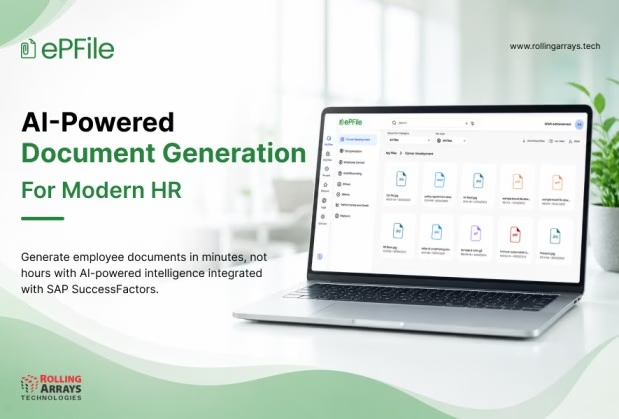
Artificial intelligence has quickly become part of almost every HR technology conversation. From recruitment and workforce planning to employee support and analytics, organizations are exploring how AI can improve productivity and decision-making.
Document management has followed the same trend.
Today, many vendors describe their products as AI-powered. However, the capabilities behind those claims vary significantly. Some solutions simply automate repetitive tasks, while others use AI to intelligently generate documents, organize information, and simplify document management.
For HR leaders, the important question is no longer whether a solution uses AI. Instead, it is whether AI reduces administrative effort, improves document accuracy, and enhances employee experiences.
Organizations benefit most when AI solves practical HR challenges rather than introducing unnecessary complexity.
AI Is Changing HR, but Not Every AI Feature Delivers Value
Artificial intelligence has quickly become part of almost every HR technology conversation. From recruitment and workforce planning to employee support and analytics, organizations are exploring how AI can improve productivity and decision-making.
Document management has followed the same trend.
Today, many vendors describe their products as AI-powered. However, the capabilities behind those claims vary significantly. Some solutions simply automate repetitive tasks, while others use AI to intelligently generate documents, organize information, and simplify document management.
For HR leaders, the important question is no longer whether a solution uses AI. Instead, it is whether AI reduces administrative effort, improves document accuracy, and enhances employee experiences.
Organizations benefit most when AI solves practical HR challenges rather than introducing unnecessary complexity.
What AI Document Generation Really Means
AI document generation goes beyond replacing paper forms or digitizing templates.
Modern AI-powered document generation enables HR teams to automatically create employee documents using predefined business rules, employee data, and configurable templates.
Examples include:
- Offer letters
- Employment contracts
- Promotion letters
- Salary revision letters
- Confirmation letters
- Experience letters
- Policy acknowledgements
- HR certificates
Instead of manually copying employee information into templates, HR professionals can generate accurate, standardized documents within minutes.
This approach reduces repetitive administrative work while improving consistency across the employee lifecycle.
Separating Reality from Marketing Hype
Not every AI capability delivers practical value. Organizations see the greatest benefits when AI supports HR teams by simplifying document-intensive processes rather than replacing human decision-making.
Modern AI-powered document management helps organizations:
- Reduce repetitive document-related tasks instead of replacing HR professionals.
- Generate employee documents using approved templates and business rules.
- Improve document accuracy and consistency across the employee lifecycle.
- Follow configurable workflows to maintain governance and compliance.
- Streamline document-intensive HR processes where AI delivers measurable business value.
Organizations that focus on these practical outcomes are more likely to achieve long-term success with AI.
Where AI Creates the Greatest Impact in HR Document Management
Employee document generation is one of the most repetitive administrative responsibilities within HR.
Every employee journey generates multiple documents that often require manual preparation, approvals, formatting, and storage.
AI helps simplify these activities by:
- Automatically generating employee documents using approved templates
- Populating employee information from HR systems
- Reducing manual data entry
- Improving document consistency
- Accelerating document preparation
- Supporting standardized HR processes
Rather than changing established HR workflows, AI enhances them by making document-intensive tasks faster, more accurate, and easier to manage.
How AI Powered Document Generation Works
Modern AI document generation combines employee data, configurable templates, business rules, and workflow automation to create accurate, consistent HR documents.
Instead of manually preparing each document, HR teams can generate standardized documents using information already available in SAP SuccessFactors.
A typical AI-powered document workflow includes:
- Selecting the required document template.
- Retrieving employee information from SAP SuccessFactors.
- Automatically populating document fields.
- Generating a formatted document.
- Routing the document through configurable approval workflows.
- Sending the document for digital signature, if required.
- Securely storing the completed document within a centralized repository.
This approach reduces manual effort while ensuring every document follows approved templates and organizational standards.
Why Organizations Are Investing in AI Personnel Files
As organizations grow, managing employee documents manually becomes increasingly challenging. Employee records expand throughout the employee lifecycle, making it difficult to maintain consistency across multiple business units, locations, and HR teams.
AI personnel files help organizations create a more connected and intelligent document management experience.
Key capabilities include:
Intelligent Document Generation
Generate employee documents automatically using configurable templates and live employee data, reducing repetitive manual work.
Centralized Document Management
Store employee documents securely within a centralized repository that supports easy access, organization, and governance.
Intelligent Search
Locate employee documents quickly using OCR-powered search, employee names, document IDs, keywords, and metadata.
Workflow Automation
Route documents through configurable approval workflows while maintaining complete approval history and document traceability.
Digital Signatures
Accelerate document completion through integrated digital signature workflows while maintaining secure records.
Role Based Security
Protect sensitive employee information through configurable permissions and role-based access controls.
Together, these capabilities create a more efficient and scalable approach to employee document management.
Extending SAP SuccessFactors with Intelligent Document Management
SAP SuccessFactors provides a strong foundation for managing employee data and core HR processes. As organizations continue to modernize HR operations, many are extending their existing environment with intelligent document management capabilities.
Solutions such as ePFile by Rolling Arrays Technologies help organizations:
- Generate employee documents using AI-powered templates
- Automatically populate employee information from SAP SuccessFactors
- Centralize employee document management
- Enable OCR-powered document search
- Automate approval workflows
- Support digital signatures
- Strengthen governance through role-based access controls
Rather than introducing another disconnected application, organizations can enhance document-intensive HR processes while continuing to work within SAP SuccessFactors.
What HR Leaders Should Look for in an AI Document Generation Solution
When evaluating AI document generation solutions, organizations should look beyond AI claims and focus on practical business outcomes.
Consider whether the solution can:
- Generate documents using configurable templates
- Integrate with existing HR systems
- Reduce manual document preparation
- Support workflow automation
- Enable secure digital signatures
- Centralize employee document management
- Strengthen governance and compliance
- Scale across multiple countries and business units
The most effective solutions combine AI with structured document management, enabling HR teams to improve efficiency while maintaining control over employee records.
Business Benefits of AI Powered Document Generation
Organizations adopting AI-powered document generation are improving more than document creation. They are reducing administrative effort, strengthening governance, and delivering a better employee experience throughout the document lifecycle.
Reduce Manual Effort
HR teams spend significant time creating, reviewing, and managing employee documents. AI-powered document generation automates repetitive tasks, allowing HR professionals to focus on strategic initiatives instead of manual administration.
Improve Document Accuracy and Consistency
AI-powered templates automatically populate employee information from SAP SuccessFactors, reducing manual data entry and helping ensure documents remain consistent, accurate, and aligned with organizational standards.
Accelerate HR Processes
Automated document generation, workflow-driven approvals, and digital signatures reduce turnaround times for employee documents, helping HR teams respond faster to business and employee needs.
Strengthen Governance and Compliance
Centralized document management, role-based access controls, approval history, and secure document storage help organizations maintain better governance while supporting compliance requirements.
Enhance Employee Experience
Employees can receive important documents more quickly through standardized, automated processes. Faster document generation and retrieval improve responsiveness while reducing dependency on HR teams for routine requests.
How AI Improves Traditional Document Creation
Traditional document creation often relies on manual templates, repeated data entry, email-based approvals, and storing documents across multiple locations. These activities consume valuable HR time and increase the risk of inconsistencies.
AI-powered document generation simplifies these processes by:
- Automatically populating employee information from SAP SuccessFactors.
- Generating standardized documents using configurable templates.
- Routing documents through automated approval workflows.
- Supporting digital signatures for faster completion.
- Storing employee documents in a centralized, secure repository.
- Reducing manual effort while improving governance and consistency.
This approach enables HR teams to spend less time on administration and more time supporting employees and business priorities.
Conclusion
AI is transforming HR document management, but its value lies in solving practical business challenges rather than simply adding automation. Organizations that implement AI-powered document generation can reduce manual effort, improve document accuracy, accelerate HR processes, and strengthen governance without changing their existing HR systems.
By combining AI-powered document generation with centralized document management, intelligent search, workflow automation, and digital signatures, organizations create a more efficient and scalable approach to managing employee documents.
ePFile by Rolling Arrays Technologies extends SAP SuccessFactors with intelligent document management capabilities, helping organizations modernize employee document generation while maintaining security, governance, and a seamless HR experience.
Looking to modernize employee document generation within SAP SuccessFactors?
Discover how ePFile helps organizations automate document generation, centralize employee documents, streamline approvals, and strengthen document governance with AI-powered capabilities.
Explore ePFile or connect with our team to learn more.
Frequently Asked Questions About SAP SuccessFactors Document Management
What is AI document generation in HR?
AI document generation in HR uses intelligent automation, configurable templates, and employee data to create HR documents such as offer letters, contracts, promotion letters, and employment certificates with minimal manual effort.
How does AI improve employee document management?
AI helps automate document generation, standardize document formats, reduce manual data entry, and improve document accuracy. Combined with centralized document management, it also simplifies document retrieval and governance.
Can AI replace HR professionals?
No. AI supports HR professionals by automating repetitive document-related tasks. HR teams continue to manage approvals, employee interactions, policy decisions, and compliance while AI improves operational efficiency.
What types of HR documents can AI generate?
Can AI document generation integrate with SAP SuccessFactors?
Yes. Solutions such as ePFile by Rolling Arrays Technologies extend SAP SuccessFactors by automatically generating employee documents using employee data while supporting workflow automation, digital signatures, and centralized document management.
How does ePFile support AI document generation?
ePFile helps organizations generate employee documents using AI-powered configurable templates, automatically populate employee data from SAP SuccessFactors, automate approval workflows, enable digital signatures, and securely manage documents throughout the employee lifecycle.



One Comment