

Finance and HR leaders ask the same question every quarter: how much of our expense is actually compliant?
The answer is rarely reassuring.
Oversight’s spend analysis research found that 10% of business travelers have at least one duplicate expense in their claims. Separately, industry data citing the Association of Certified Fraud Examiners shows the median loss per expense fraud case runs around $50,000, with U.S. organisations losing an estimated $2.8 billion annually to expense fraud overall.
This is not a finance problem alone. It is a governance problem that touches HR, Finance, and the CHRO’s broader compliance mandate.
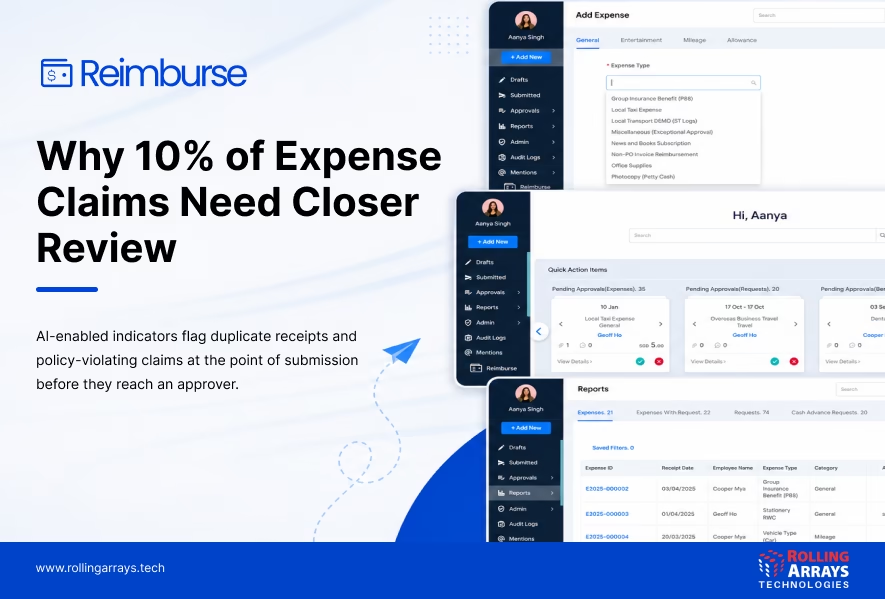
Reimburse uses AI-enabled indicators that flag duplicate receipts and policy-violating claims at the point of submission, so non-compliant spend doesn’t reach your ledger unnoticed.
Why Duplicate Expense Claims and Non-Compliant Spend Persist
Three structural gaps, not isolated mistakes, create this problem.
Manual Processes Create Blind Spots
Most teams still rely on spreadsheets, email chains, and disconnected approval workflows as the norm. Someone submits a receipt in week one, and it can reappear in week three under a slightly different date or merchant name, with no automated cross-check to catch it. Finance teams end up relying on institutional memory. That does not scale.
Policy Complexity Outpaces Enforcement
- Per diem limits by country
- Meal allowances by seniority
- Advance approval requirements for international travel
- Category-specific spend caps
When a policy document holds these rules instead of the submission system itself, the gap between stated policy and actual practice widens every cycle. Duplicate expense claims HR and finance teams encounter most often aren’t fraud, they’re genuine confusion, like someone filing a receipt twice across reporting periods. The system can’t tell the difference. The financial impact is identical either way.
A Small Minority Is Deliberate
- Inflated receipts
- Fabricated vendor claims
- Personal expenses submitted under business categories
These are not edge cases at enterprise scale. Manual audit alone reacts too slowly, and too inconsistently, to deter either duplicate claims or genuine expense fraud.
What Ineffective Expense Management Actually Costs
The direct cost is the dollar value of non-compliant claims that approvers approve. The indirect costs are what most boards never itemise.
The cost of poor expense management can be seen across several areas. Finance team hours are spent on manual claim reviews, duplicate investigations, and policy exception handling. Audit exposure increases when expense records are incomplete, inconsistently categorised, or poorly documented. Leadership credibility can be affected when board-level expense reporting cannot be reconciled with transaction-level data. Finally, employee experience suffers when a slow and opaque review process delays legitimate claims.
These costs compound fast in organisations with distributed workforces, multi-country operations, or high-frequency travel programmes.
What a Modern Expense Solution Must Deliver
Three capabilities are non-negotiable for enterprise expense compliance. Each one maps directly to a cost above.
AI-powered detection at the point of submission helps reduce finance team hours and improve the employee experience. A verifiable audit trail helps minimise audit exposure, while policy enforcement built into the workflow strengthens leadership credibility.
AI-Powered Detection at the Point of Submission
The right intervention happens before an approver approves a claim, not after. This approach removes the manual review burden driving up finance team hours, and it closes the delay damaging employee experience, since the system checks claims instantly instead of queuing them.
A Verifiable Audit Trail
The system needs to log and trace every claim, approval, and policy flag. This solves audit exposure directly and turns audit-readiness into a by-product of normal operations, not a fire drill before a compliance review.
Policy Enforcement Built Into the Workflow
Approval hierarchies, spend limits, category restrictions, and conditional logic need to live inside the submission flow, not a document. This protects leadership credibility and lets teams reconcile board-level reporting with transaction-level data, because the same rules already constrained every claim at submission.
How Reimburse Addresses Duplicate Expense Claims and Compliance Gaps
AI-Powered OCR and Receipt Validation
Reimburse extracts data from receipts and bills automatically, removing the manual data entry step that introduces errors. AI-enabled indicators flag duplicate receipts and policy-violating claims before they reach an approver.
Built-In Audit Trail
Reimburse logs every submission, approval, and escalation, giving finance leaders full visibility into who submitted what, when, against which policy, and how each case was resolved.
Rule-Based Configuration Engine
Administrators define custom fields, approval paths, and conditional logic. Reimburse enforces policy systematically, instead of leaving reviewers to interpret it case by case.
Real-Time Insights for Finance Leadership
Reimburse delivers spending pattern and anomaly analytics in real time, so finance leaders make decisions in the moment, not retrospectively at period end.
HRIS-Agnostic Integration
Reimburse also works as an add-on within SAP SuccessFactors, where it synchronizes approved expenses directly to Employee Central for payroll processing, removing a manual handoff step for organisations already running SAP SuccessFactors as their core HR system.
Reimburse at a Glance
Rolling Arrays Technologies built Reimburse as an AI-enabled travel and expense management add-on, native to SAP SuccessFactors. It eliminates manual receipt data entry, enforces complex enterprise policies automatically at the source, and synchronizes approved expenses directly to Employee Central for payroll processing.
Ready to close the gap in your expense compliance? Request a demo today to see Reimburse in action.
Organizations don’t need to replace their HR platform to modernize document management. Instead, they can extend Employee Central with capabilities that simplify the complete employee document lifecycle.
From Reactive to Preventive: The Finance Director’s Imperative
This benchmark is not inevitable. It reflects three process conditions: manual submission, disconnected systems, post-facto review. AI-enabled solutions replace all three.
Reimburse shifts expense management from a reactive compliance exercise to one that runs on AI-enabled indicators and a full audit trail:
- AI-enabled indicators flag duplicates and policy violations as claims come in
- The audit trail handles accountability
- Finance leadership retains the strategic visibility needed to govern spend
Reimburse is an enterprise travel and expense solution by Rolling Arrays Technologies, recognised as Best SAP Store/OEM Partner at the SEA Partner Success Summit 2025. Deployed across 20+ countries and 50+ languages.
To explore how Reimburse can address expense compliance in your organisation: rollingarrays.tech.
Frequently Asked Questions About SAP SuccessFactors Document Management
How does AI validation transform traditional duplicate expense claim detection?
Traditional duplicate expense claim detection relies on manual, after-the-fact review, where finance teams catch duplicate or policy-violating claims only during periodic audits, long after approval and reimbursement. AI validation moves detection to the point of submission instead. The system cross-references receipt data the moment someone submits a claim, flags duplicates and policy violations instantly, and stops non-compliant spend before it reaches an approver. This shifts expense governance from a reactive, retrospective audit function to a preventive control that operates in real time.
Why do duplicate expense claims occur in large organisations?
Three common causes:
-
- Disconnected submission systems
- Manual data entry errors
- No automated cross-referencing between claim batches
In large, distributed workforces, one person or two can submit the same receipt twice without either party knowing. Without system-level detection, organisations usually only catch this during periodic audits, if they catch it at all.
How does Reimburse flag duplicate expense claims?
Reimburse uses AI-enabled indicators to flag duplicate receipts and policy-violating claims at the point of submission. A built-in audit trail makes every flagged item traceable, removing reliance on manual spot-checks.
Does Reimburse integrate with any HRIS, or is it limited to specific platforms?
Reimburse is HRIS-agnostic. It integrates with existing HR and finance systems rather than requiring a single platform, making it suitable for multi-platform or transitional environments. It’s also available as a native add-on for organisations running SAP SuccessFactors.
What reporting capabilities does Reimburse offer finance teams?
Real-time dashboards covering expense trends, team-level spending, and audit-readiness data, available continuously rather than only at period end.


