

Artificial intelligence is creating new opportunities for HR teams to improve employee experiences, simplify administrative processes and make better use of workforce information. However, successful AI adoption in HR requires more than implementing new technology. CHROs must also address employee trust, data privacy, transparency, accountability and the role of human judgment in AI supported processes.
As AI becomes part of everyday HR interactions, employees and managers need to understand how it supports their work, how their information is used and when human intervention remains necessary. Without these safeguards, organisations risk undermining the very employee experience they want to improve.
Responsible AI in HR gives HR leaders a framework for balancing innovation with accountability. By establishing clear governance, defining appropriate boundaries for AI actions and maintaining meaningful human oversight, organisations can introduce AI with greater confidence. Solutions such as Rover, an Agentic AI experience platform for SAP SuccessFactors and other enterprise HR systems, illustrate how organisations can make HR journeys more accessible while keeping people involved in critical decisions.
Why Responsible AI in HR Matters to CHROs
For CHROs, AI adoption is not simply a technology initiative. It affects how employees access HR services, how managers complete responsibilities and how HR teams maintain consistent processes across the organisation.
Consider an employee who asks an AI assistant about leave eligibility, a manager who needs help navigating a recruitment workflow or an HR professional who wants to simplify a repetitive administrative task. AI can make these interactions easier. But employees must also be able to trust the guidance they receive and understand when a response requires further verification.
Three challenges make responsible AI particularly important.
Employee trust can determine AI adoption
Employees may hesitate to use AI when they do not understand its purpose, how it handles personal information or whether its recommendations influence important workplace decisions.
If employees cannot distinguish between an AI generated suggestion and an approved HR decision, uncertainty can reduce confidence in both the technology and the HR function.
CHROs must therefore communicate clearly about where AI is used, what it can do and where human judgment remains essential. Trust grows when employees understand the boundaries of the technology and know how to seek clarification.
AI risks can affect fairness and accountability
AI systems can produce inaccurate outputs, reflect biases in historical data or provide recommendations without sufficient organisational context. These risks become particularly significant when AI influences recruitment, performance evaluation, promotion, compensation or other employment decisions.
Automation does not remove accountability. HR leaders must establish who reviews AI outputs, who approves consequential actions and who addresses errors or concerns.
Fragmented HR systems can complicate responsible adoption
Many organisations operate complex HR technology environments with multiple modules, workflows and access points. Employees may need to navigate several systems to complete a single HR journey.
Adding AI without considering this complexity can introduce another layer of confusion. Responsible AI adoption should simplify how people interact with existing HR systems while respecting established access controls, processes and decision making responsibilities.
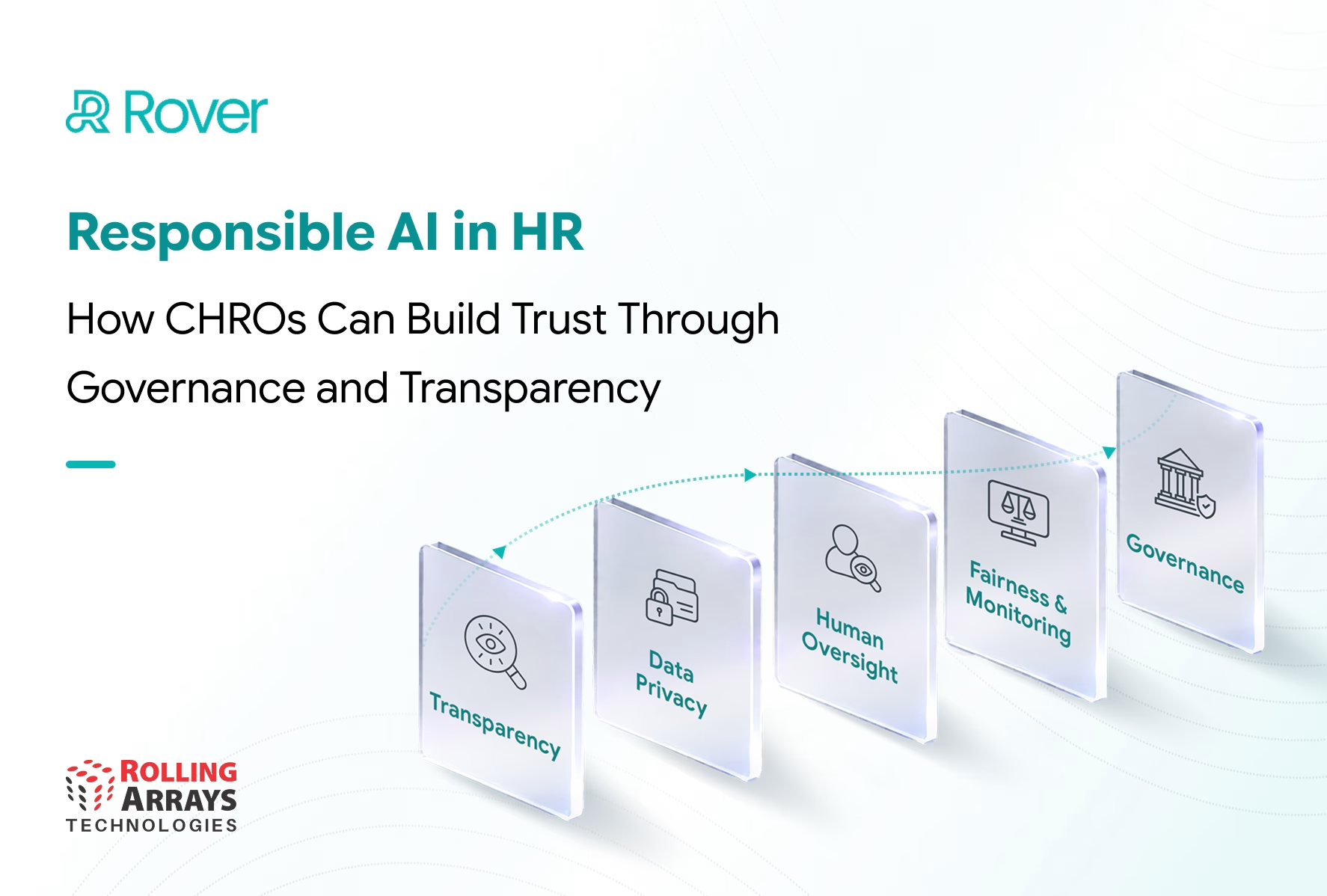
The Five Pillars of Responsible AI in HR
Responsible AI in HR requires a practical framework that connects technology decisions to employee experience, operational efficiency and organisational accountability.
1. Transparency in AI supported HR processes
Employees should know when they are interacting with AI and understand the purpose of the interaction. HR leaders should explain what the AI assistant can help with, what information it may use and when a response needs human review.
Transparency also means communicating limitations. AI generated guidance should not be presented as a definitive policy interpretation or an approved decision when additional verification is required.
For CHROs, the objective is straightforward: make AI understandable enough for employees and managers to use it confidently and responsibly.
2. Data privacy and appropriate access
HR systems handle sensitive information related to employees, compensation, performance, leave and other aspects of employment. AI adoption must respect the organisation’s data protection requirements and established access permissions.
Before introducing an AI solution, HR and IT leaders should determine what information the system needs, why it needs that information and which users should be permitted to access it.
Organisations should also assess vendor security practices, data handling arrangements, retention requirements and applicable privacy obligations. Access should follow business need rather than the broad availability of information.
These safeguards help organisations manage AI risks in HR without unnecessarily restricting useful employee and manager experiences.
3. Human oversight and clear accountability
AI can help people find information, organise tasks, generate recommendations and navigate workflows. However, organisations should not automatically delegate consequential employment decisions to AI systems.
CHROs should distinguish between activities that AI can support independently within approved boundaries, activities that require human review and decisions that must remain under human ownership.
For example, an AI assistant may help a manager navigate a hiring workflow or prepare information for review. The organisation should still define who has authority to approve the headcount, evaluate candidates and make the final hiring decision.
Human oversight must be meaningful. Reviewers need the authority, information and time to question an output, correct an error or stop an inappropriate action.
4. Fairness and continuous monitoring
Responsible AI requires ongoing evaluation rather than a one time approval before deployment.
HR leaders should assess whether AI outputs are accurate, appropriate and consistent with organisational policies. Where AI influences people related decisions, organisations should evaluate potential bias and review outcomes across relevant employee groups.
Monitoring should also consider employee feedback, recurring errors, unexpected recommendations and changes in how the technology is used.
When organisations identify a problem, they need a clear process for investigating it, correcting the issue and reassessing whether the AI use case remains appropriate.
5. Governance that supports responsible innovation
AI governance should not become a barrier that prevents every useful application. Instead, it should help organisations determine where AI adds value and what safeguards each use case requires.
HR, IT, information security, legal, compliance and risk teams should collaborate to establish appropriate policies and responsibilities.
A practical governance framework should define approved use cases, access permissions, escalation procedures, human approval requirements and review responsibilities. It should also specify how the organisation evaluates new AI capabilities before expanding their use.
By connecting governance to business priorities, CHROs can scale AI adoption in HR without losing sight of employee trust and operational accountability.
How CHROs Can Introduce AI Responsibly
A responsible AI strategy should begin with a clear business problem rather than a decision to adopt AI simply because the technology is available.
Start with employee and business needs.
Identify HR journeys where employees face unnecessary complexity, managers spend too much time navigating processes or HR teams handle repetitive requests. Prioritise use cases where AI can improve the experience without introducing disproportionate risk.
Classify use cases by risk.
Distinguish routine information retrieval and administrative support from activities that can influence employment opportunities or outcomes. Apply stronger review and approval requirements to higher impact use cases.
Define boundaries before deployment.
Establish what the AI solution can access, recommend and do. Identify the situations that require human approval or escalation, and ensure that the responsibilities of HR teams and managers remain clear.
Communicate with employees and managers.
Explain why the organisation is introducing AI, how people can use it and where they can obtain human assistance. Provide training that helps users understand both the benefits and limitations of the technology.
Measure outcomes and improve continuously.
Track indicators such as task completion time, employee experience, HR service efficiency, accuracy, escalation rates and user feedback. Review these measures alongside privacy, fairness and governance requirements.
This approach allows CHROs to assess AI adoption through both business performance and responsible use.
How Rover Supports a More Connected HR Experience
Responsible AI also depends on how organisations introduce AI into the systems employees and managers already use. A solution that adds complexity or obscures accountability can weaken adoption, even when its underlying technology is capable.
Rover, the Agentic AI experience platform from Rolling Arrays Technologies, is designed to simplify interactions across enterprise HR systems, including SAP SuccessFactors, Workday and Oracle HCM. It brings HR journeys into a conversational experience, helping employees, managers and HR teams access guidance and progress through multi step processes without repeatedly navigating different screens.
For CHROs, this approach addresses a practical challenge: making existing HR technology easier to use while keeping the organisation’s HR processes and responsibilities in view.
Rover’s Human in the Loop architecture reflects the importance of retaining human control over critical decisions. Its journey based approach also allows organisations to begin with selected employee or HR workflows and expand according to business priorities.
For example, organisations can explore journeys such as initiating a new hire request or raising an HR query through a chatbot. These interactions can help reduce navigation effort and make HR services more accessible. The organisation must still define the applicable permissions, approval requirements and responsibilities for each workflow.
Rover should therefore be considered as part of a broader responsible AI strategy, not as a substitute for AI governance. The organisation remains responsible for defining appropriate use, protecting employee information, evaluating outcomes and ensuring that people retain the necessary control over consequential decisions.
The objective is to make enterprise HR technology easier to access and use while supporting a governed, human centred employee experience.
Measuring the Success of Responsible AI in HR
CHROs should evaluate responsible AI through a combination of operational, employee experience and governance indicators.
| Measurement area | Example indicators |
| Employee experience | User satisfaction, ease of completing HR journeys, employee feedback |
| Operational efficiency | Time to complete workflows, reduction in repetitive requests, HR service turnaround time |
| Quality and reliability | Accuracy of guidance, error rates, escalation frequency |
| Governance | Compliance with approval processes, access control reviews, completion of risk assessments |
| Trust and adoption | Active usage, employee understanding of AI, confidence in available human support |
A responsible AI initiative should demonstrate that it improves the way people interact with HR while maintaining appropriate safeguards and accountability.
Conclusion: Responsible AI Starts with People
AI in human resource management offers an opportunity to simplify HR operations, improve access to services and give employees and managers more time for meaningful work. However, these benefits depend on how organisations introduce and govern the technology.
For CHROs, responsible AI in HR means building transparency into employee interactions, protecting personal information, defining clear accountability, monitoring fairness and maintaining meaningful human oversight.
The goal is not to automate every HR activity. It is to identify where AI can help people work more effectively while preserving human judgment where it matters most.
Rover supports this direction by providing a conversational, Agentic AI experience across enterprise HR systems and incorporating a Human in the Loop approach for critical decisions. As organisations explore this next stage of HR transformation, the priority should remain clear: make HR technology more accessible, make processes more effective and make AI adoption worthy of employee trust.
Responsible AI is not simply about controlling technology. It is about creating better HR experiences through innovation that remains transparent, accountable and human centred.
Explore how Rover connects your existing HR systems through conversational AI while supporting human oversight.
Frequently Asked Questions
What is responsible AI in HR?
Responsible AI in HR means using artificial intelligence in ways that support business and employee needs while addressing privacy, fairness, transparency, security and accountability. It includes defining appropriate use cases, monitoring outcomes and maintaining human oversight where necessary.
Why is AI governance in HR important?
AI governance helps organisations define how AI can be used, which information it can access, who is accountable for outcomes and when human review is required. It supports consistent implementation while helping HR leaders manage operational, ethical and compliance risks.
What are the main AI risks in HR?
Common risks include inaccurate outputs, potential bias, inappropriate access to employee information, unclear accountability and excessive reliance on automated recommendations. These risks require appropriate safeguards, continuous monitoring and clear escalation processes.
How can organisations encourage AI adoption in HR?
Organisations can encourage adoption by starting with genuine employee and business needs, communicating clearly about AI use, providing relevant training and making human assistance available. They should also measure whether AI improves the experience and outcomes for employees, managers and HR teams.
What is the difference between ethical AI and responsible AI in HR?
Ethical AI focuses on principles such as fairness, transparency, privacy and respect for people. Responsible AI puts those principles into practice through governance, access controls, oversight, monitoring and accountability.
Should AI make final HR decisions?
AI can support analysis, provide recommendations and simplify workflows. However, consequential employment decisions, such as hiring, promotion, compensation and termination, require carefully defined human accountability and meaningful oversight appropriate to the use case.
How does Rover support responsible AI adoption in HR?
Rover provides a conversational Agentic AI experience across enterprise HR systems and supports employees, managers and HR teams as they navigate HR journeys. Its Human in the Loop architecture supports human control over critical decisions. Organisations must still establish their own policies, access controls, approval processes and governance requirements for each use case.


