

Many enterprises have invested in SAP SuccessFactors and built extensive workforce data across the employee lifecycle. Yet having data does not automatically create mature workforce analytics.
HR leaders often progress through different stages, from basic reporting to dashboards and eventually more intelligent, predictive analytics. Understanding where the organization currently stands helps CHROs identify gaps and build a practical HR analytics strategy.
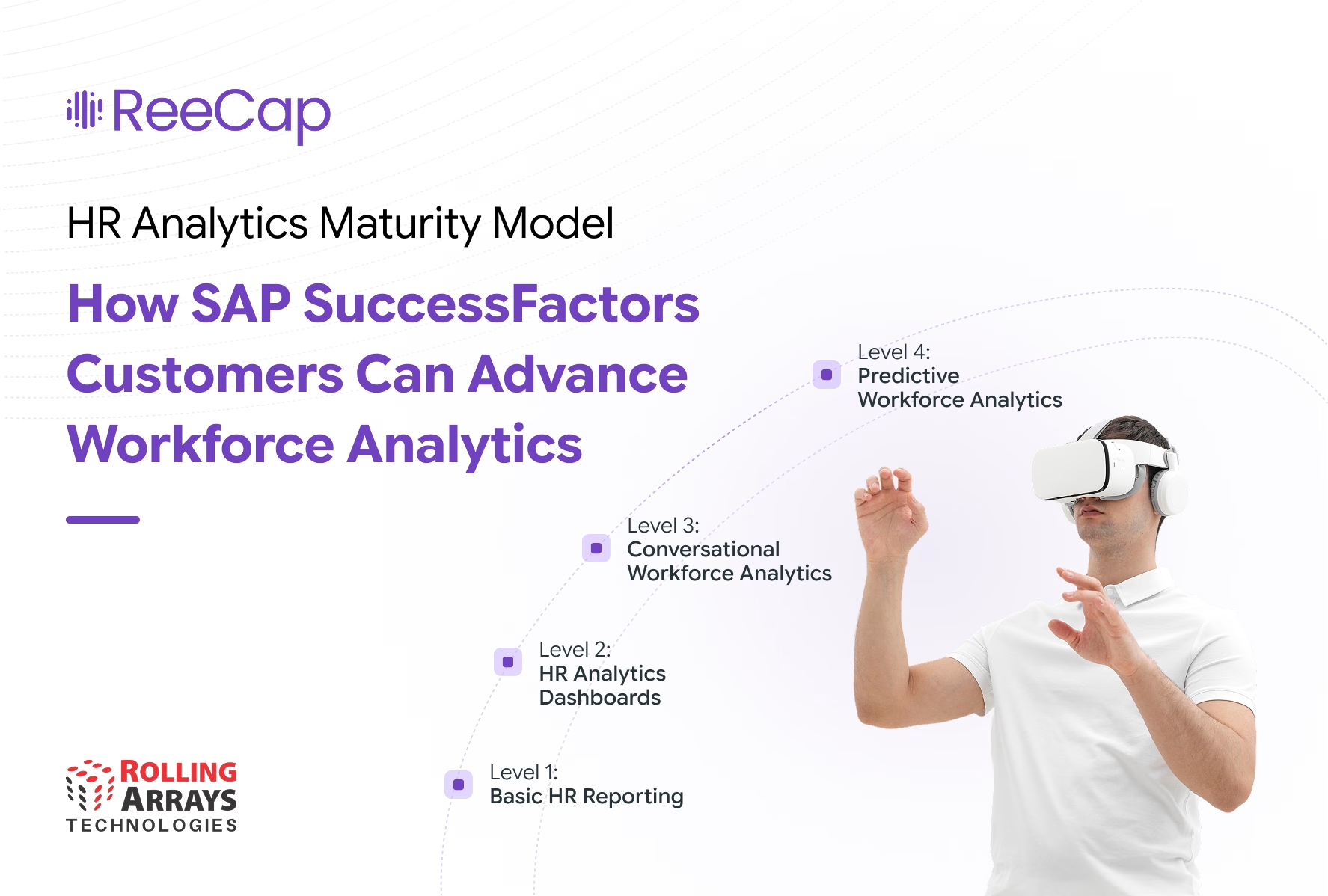
This HR analytics maturity model outlines four stages, showing how organizations can progress from reporting what happened to understanding what is happening, exploring data conversationally, and anticipating what could happen next.
Why HR Analytics Maturity Matters to CHROs
For CHROs, the challenge is not simply accessing HR data. The challenge is using that data to answer increasingly strategic workforce questions.
At an early stage, HR teams may spend considerable time preparing reports. As analytics capabilities mature, leaders can explore workforce trends more easily, identify patterns, and eventually use predictive insights to support workforce planning.
Without a clear maturity framework, organizations may invest in individual reports or dashboards without creating a connected analytics strategy.
A maturity model gives HR leaders a way to ask:
- Where are we today?
- What can our current analytics capability answer?
- Where do we still depend on manual reporting?
- How easily can HR leaders explore new questions?
- Can we identify emerging workforce risks?
- What should the next stage of our analytics journey look like?
The Four Levels of HR Analytics Maturity
The workforce analytics maturity model can be viewed as four progressive levels:
Level 1: Basic Reporting → Level 2: Dashboards → Level 3: Conversational Analytics → Level 4: Predictive Analytics
Each level addresses a different business need.
Level 1: Basic HR Reporting
At the first stage, organizations primarily use HR data to understand what has already happened.
HR teams generate reports covering areas such as:
- Headcount
- Attrition
- Recruitment
- Attendance
- Performance
- Compensation
- Learning
These reports provide important visibility into workforce activity.
However, HR teams often need to define the report, select the required metrics, apply filters, and interpret the results manually.
The CHRO Challenge at Level 1
The biggest challenge is often reporting effort.
When leadership asks a new workforce question, HR teams may need to create another report or request additional analysis.
The organization has HR data, but accessing the right insight can take time.
Level 2: HR Analytics Dashboards
The second stage introduces interactive dashboards that bring multiple workforce metrics together.
An HR analytics dashboard can provide a centralized view of important workforce indicators and allow users to filter information by dimensions such as department, location, job level, or time period.
Dashboards help HR leaders move beyond individual reports and identify workforce trends more efficiently.
The CHRO Challenge at Level 2
Dashboards improve visibility, but they still depend on users knowing what to look for.
A dashboard can show that attrition increased.
The CHRO may still need to investigate:
Why did it increase?
Which workforce groups contributed to the change?
What factors should we examine next?
This creates the need for a more interactive analytics experience.
Level 3: Conversational Workforce Analytics
The third stage introduces conversational analytics powered by AI.
Instead of navigating predefined reports and dashboards, HR leaders can ask workforce questions using natural language.
For example:
“Which departments have experienced the highest increase in attrition?”
The next question could be:
“How does this compare with last year?”
And then:
“Which employee groups contribute most to this trend?”
This creates a more natural way to explore workforce data.
How ReeCap Supports Level 3
ReeCap brings AI-first analytics to SAP SuccessFactors and uses Large Language Model technology to help users interact with workforce data conversationally.
Users can query data, explore trends, and drill into insights without requiring data science expertise.
This helps organizations move from dashboard consumption to interactive workforce analysis.
The value for CHROs comes from making analytics more accessible across HR and business leadership rather than limiting deeper analysis to technical specialists.
Level 4: Predictive Workforce Analytics
The fourth stage moves beyond understanding historical and current workforce trends toward anticipating what could happen next.
Predictive workforce analytics can help organizations explore questions such as:
- Where could attrition increase?
- Which workforce segments may require attention?
- What skills gaps could affect future plans?
- Which workforce trends should leadership monitor?
- Where should HR focus workforce planning efforts?
From Insight to Forward Looking Decisions
At this stage, analytics becomes an important component of strategic workforce planning.
ReeCap supports predictive and prescriptive analytics by analyzing historical and current workforce data alongside relevant benchmarks to help forecast trends such as retention, productivity, and HR process performance.
This allows HR leaders to consider potential future scenarios alongside historical workforce information.
How to Build an HR Analytics Strategy Around Maturity
An effective HR analytics strategy should focus on business outcomes rather than simply increasing the number of reports or dashboards.
CHROs can assess their current maturity by asking:
Are We Still Spending Significant Time Preparing Reports?
If yes, the organization may benefit from strengthening its reporting and dashboard capabilities.
Can HR Leaders Explore New Questions Independently?
If users depend heavily on analysts for every new question, conversational analytics can help make workforce data more accessible.
Can We Identify Emerging Workforce Trends?
If analytics primarily describes historical activity, predictive capabilities can help HR leaders move toward forward-looking workforce planning.
Can We Connect Analytics with Business Priorities?
The ultimate goal is not simply more advanced technology. It is the ability to use workforce intelligence to support better decisions.
Advancing SAP SuccessFactors Analytics with ReeCap
SAP SuccessFactors provides organizations with extensive workforce data across the employee lifecycle.
ReeCap adds an AI-first analytics layer that helps organizations extract more value from that data.
Its capabilities span workforce demographics, talent acquisition, attendance, learning, performance, engagement, rewards, skills, and employee exits. It also supports predictive analytics and AI-driven recommendations.
This allows organizations to progress from:
Reporting → Visualization → Conversation → Prediction
without treating each stage as a disconnected analytics initiative.
What the Mature HR Analytics Function Looks Like
A mature analytics function does more than produce reports.
It allows HR leaders to move naturally between different levels of analysis:
What happened?
↓
What is happening now?
↓
Why is it happening?
↓
What could happen next?
↓
What should we consider doing?
This progression creates a more strategic role for workforce analytics.
For CHROs, maturity means having the ability to move from operational reporting to workforce intelligence that supports business planning and decision-making.
Key Takeaways
- An HR analytics maturity model helps organizations understand their current analytics capabilities and identify their next stage of development.
- Level 1 focuses on basic reporting and understanding historical workforce activity.
- Level 2 introduces dashboards that make workforce trends easier to explore.
- Level 3 uses conversational analytics to help non-technical users interact with workforce data naturally.
- Level 4 introduces predictive analytics to support forward-looking workforce planning.
- ReeCap helps SAP SuccessFactors customers progress toward AI-first, conversational, predictive, and prescriptive workforce analytics.
- The objective of an HR analytics strategy should be better workforce decisions, not simply more reports or more advanced technology.
Take the Next Step in Your HR Analytics Journey
Explore how ReeCap can extend SAP SuccessFactors analytics capabilities and help your HR team make more informed workforce decisions.
Frequently Asked Questions
What is an HR analytics maturity model?
An HR analytics maturity model is a framework that helps organizations understand how their workforce analytics capabilities progress from basic reporting toward more advanced, conversational, predictive, and prescriptive analytics.
What are the four levels of workforce analytics maturity?
A practical four-level framework includes basic reporting, dashboards, conversational analytics, and predictive analytics. Each stage gives HR teams greater ability to explore and act on workforce information.
How can SAP SuccessFactors customers improve their analytics maturity?
Organizations can assess their current reporting and analytics capabilities, identify gaps, and progressively introduce dashboards, AI-powered conversational analytics, and predictive workforce insights.
How does ReeCap support HR analytics maturity?
ReeCap provides an AI-first analytics layer for SAP SuccessFactors that supports dashboards, conversational data exploration, predictive analytics, AI-driven recommendations, and executive-ready workforce insights.
Why does HR analytics maturity matter to CHROs?
Greater analytics maturity can help CHROs move from manually reporting historical workforce activity toward exploring workforce trends, identifying emerging risks, and supporting forward-looking strategic workforce planning.


