

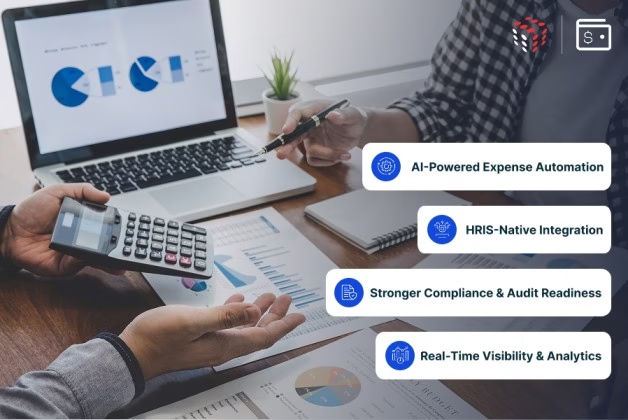
Every expense report appears simple on the surface. An employee uploads a receipt, a manager approves it, and Finance processes the reimbursement. But behind that routine workflow lies a significant operational cost that many organizations underestimate.
Industry research suggests that processing a single expense report can take 20–30 minutes when receipt verification, policy checks, approvals, and reconciliation are handled manually. At enterprise scale, this translates into hundreds of administrative hours every month.
In many SAP SuccessFactors environments, core HR operations are already structured. Employee master data, organizational hierarchies, approval relationships, and cost centres are centralized within the HRIS. Yet expense management frequently remains fragmented across emails, spreadsheets, shared folders, and disconnected systems.
The result is not just slower reimbursements. It is growing administrative overhead, reduced financial visibility, compliance exposure, and employee frustration.
While this article focuses on SAP SuccessFactors environments, the same challenge affects organizations using Workday, Oracle HCM, and other modern HR platforms where expense workflows remain disconnected from core employee and finance systems.
Why HRIS Alone Is Not Enough for Expense Management
SAP SuccessFactors, Workday, and Oracle HCM are powerful enterprise HR systems. However, none of them are designed to handle end-to-end enterprise expense management natively.
Expense claims, receipt validation, multi-currency reimbursements, duplicate fraud detection, travel requests, policy enforcement, and audit-ready approvals require capabilities beyond what a core HRIS typically provides out of the box.
For example, most HRIS platforms are not designed to automatically validate receipts against company policies, detect duplicate claims, identify suspicious spending patterns, perform AI-powered OCR extraction, enforce country-specific reimbursement rules, or provide audit-ready expense workflows. As a result, many organizations still rely on manual reviews, spreadsheets, and disconnected processes to bridge these gaps.
This creates a gap that many CFOs, HR leaders, and HRIS managers eventually encounter. Employees submit claims through one workflow, approvals happen elsewhere, Finance validates expenses manually, and HR teams step in when employee or organizational data does not sync correctly.
The issue is not that the HRIS is insufficient. The issue is that expense management often remains disconnected from the broader HR and finance ecosystem.
Why Manual Expense Reporting Persists
Many organizations continue using manual or semi-manual expense workflows because they evolved gradually over time.
Employees submit receipts through email or mobile uploads. Managers review claims manually. Finance validates receipts and policy compliance. Payroll or ERP teams later reconcile reimbursement data.
This process may appear manageable at a smaller scale. But as organizations grow across departments, countries, and employee populations, operational complexity increases rapidly.
What begins as a reimbursement workflow eventually becomes a cross-functional coordination burden involving HR, Finance, managers, employees, payroll teams, and auditors.
The Hidden Costs CFOs Rarely See
The real cost of manual expense reporting is rarely limited to reimbursement itself.
- Administrative Labor Costs
HR and Finance teams spend considerable time validating receipts, reviewing policy exceptions, following up on missing documentation, and reconciling reimbursement records. - Approval Delays
Manual routing slows approvals and increases reimbursement turnaround times, negatively affecting employee experience. - Policy Leakage
Out-of-policy expenses may slip through when validation depends heavily on manual review and inconsistent policy interpretation. - Fraud and Duplicate Claims
In high-volume enterprises, duplicate submissions, altered receipts, and inconsistent entries can go unnoticed. AI-driven risk scoring and duplicate detection are increasingly becoming essential capabilities for enterprise finance operations. - Audit and Compliance Burden
Missing receipts, incomplete approval trails, and inconsistent records create audit exposure and compliance risk. - Limited Financial Visibility
Without real-time reporting, finance leaders struggle to identify spend trends, approval bottlenecks, and policy violations quickly enough to make informed decisions.
Why SAP SuccessFactors Environments Feel This Gap More Acutely
SAP SuccessFactors environments are particularly sensitive to disconnected expense workflows because core employee and organizational data is already centralized.
Modern enterprises do not necessarily want another disconnected expense platform. They want an expense management layer that inherits existing employee master data, approval hierarchies, cost centres, organizational structures, and role permissions directly from their HRIS environment without creating duplicate infrastructure.
- Employee data must be synchronized manually
- Cost centres require reconciliation
- Approval structures become inconsistent
- Reporting visibility becomes fragmented
This increases operational overhead across both HR and Finance teams.
APAC-Specific Complexity
For enterprises operating across Asia-Pacific, expense management complexity increases significantly due to multi-country tax requirements, currencies, languages, and regulatory obligations.
- Multi-currency reimbursements
- Country-specific tax requirements
- Regional travel-heavy workforces
- Local compliance obligations
- Cross-border approval structures
Manual expense workflows become increasingly difficult to sustain in these environments.
What Modern Expense Management Looks Like
Modern enterprise expense management is no longer just about mobile receipt submission.
- Mobile-first expense capture
- AI-powered OCR receipt extraction
- Automated policy validation
- Duplicate and fraud detection
- Configurable approval workflows
- Real-time dashboards and spend analytics
- Audit-ready reporting
- HRIS and finance integration
The shift is moving expense management from administrative processing toward intelligent operational automation.
Why HRIS-Native Add-Ons Are Replacing Standalone Expense Tools
Enterprise organizations increasingly prefer HRIS-native expense management add-ons over standalone expense tools.
- Separate login infrastructure
- Duplicate employee master data
- Parallel security governance
- Delayed synchronization
- Additional implementation overhead
Unlike standalone tools that often require separate setup, user provisioning, approval hierarchy configuration, and ongoing data synchronization, HRIS-native add-ons are designed for a more plug-and-play integration experience. By leveraging existing employee data, workflows, security models, and organizational structures within the HRIS, they can significantly reduce implementation effort and accelerate time-to-value.
- Single Sign-On (SSO)
- Employee master data
- Cost centres
- Organizational structures
- Role permissions
- Approval workflows
This reduces operational complexity while accelerating user adoption and implementation timelines.
Reimburse: AI-Powered Enterprise Expense Management
Reimburse is an AI-powered enterprise expense management platform that automates employee reimbursements, travel claims, policy checks, and approvals across SAP SuccessFactors, Workday, Oracle HCM, and modern HR systems.
Rather than replacing existing HR infrastructure, Reimburse extends it through an HRIS-native integration model.
- AI-powered OCR receipt capture
- Automated policy validation
- AI-powered expense validation and duplicate claim detection
- Configurable approval workflows
- Multi-country and multi-currency support
- Real-time spend analytics
- Audit-ready reporting
- Mobile-first expense workflows
- HRIS-inherited SSO and permissions
Reimburse is designed to reduce manual effort while improving compliance visibility and employee experience across HR and Finance operations.
Business Outcomes
Organizations adopting intelligent expense automation are increasingly seeing measurable operational improvements.
- Reduced manual administrative workload
- Faster reimbursement cycles
- Improved audit readiness
- Better compliance visibility
- Stronger financial reporting
- Improved employee experience
- Greater visibility across travel and expense operations
Expense management is no longer viewed purely as an administrative process. It is increasingly becoming part of a broader enterprise operational efficiency strategy.
Enterprise Adoption Trends
Organizations across government, healthcare, financial services, manufacturing, and enterprise services sectors are increasingly moving toward HRIS-native expense management models.
The goal is not simply reimbursement automation. It is reducing operational fragmentation across HR, Finance, payroll, and employee workflows while improving compliance and visibility.
As enterprises continue investing in SAP SuccessFactors, Workday, Oracle HCM, and modern HR ecosystems, intelligent expense automation is becoming a natural extension of digital HR transformation.
Conclusion
The future of enterprise expense management is not another disconnected tool. It is an intelligent, HRIS-native layer that extends existing HR and finance ecosystems with automation, AI validation, compliance controls, and real-time visibility.
For organizations using SAP SuccessFactors, Workday, Oracle HCM, and other modern HR platforms, the opportunity is to eliminate manual expense processing friction without replacing existing HRIS investments.
Reimburse helps enterprises automate reimbursements, travel claims, policy checks, approvals, and compliance workflows through AI-powered expense management built for modern HR environments.
Explore the Whitepaper | Read the Business Case | View the Case Study | Book a Demo
FAQ
What is enterprise expense management software?
Enterprise expense management software helps organizations automate expense claims, travel reimbursements, policy validation, approvals, and reporting. It reduces manual effort while improving compliance, visibility, and employee experience across Finance and HR teams.
Why do organizations still rely on manual expense reporting?
Many organizations continue using email approvals, spreadsheets, and disconnected workflows because expense processes have evolved gradually over time. As organizations scale, these manual processes often create approval delays, compliance risks, and administrative overhead.
How does AI improve expense management?
AI-powered expense management can automatically extract receipt data using OCR, validate expenses against company policies, detect duplicate claims, identify unusual spending patterns, and reduce the need for manual review.
What are the benefits of HRIS-native expense management?
HRIS-native expense management solutions integrate directly with employee data, approval hierarchies, cost centres, and security frameworks already available within the HRIS. This reduces implementation effort, improves data accuracy, and accelerates user adoption.
Can expense management software integrate with SAP SuccessFactors, Workday, and Oracle HCM?
Yes. Modern enterprise expense management platforms can integrate with SAP SuccessFactors, Workday, Oracle HCM, and other HR systems to streamline employee reimbursements, approvals, compliance checks, and reporting.
What are the biggest risks of manual expense reporting?
Common risks include policy violations, duplicate claims, reimbursement delays, missing documentation, audit challenges, and limited visibility into organizational spending.
What should organizations look for in an expense management solution?
Organizations should look for AI-powered OCR, policy validation, duplicate claim detection, audit-ready workflows, mobile accessibility, multi-currency support, analytics, and seamless HRIS integration. These capabilities help reduce manual effort, improve compliance, and provide greater visibility across expense operations.


